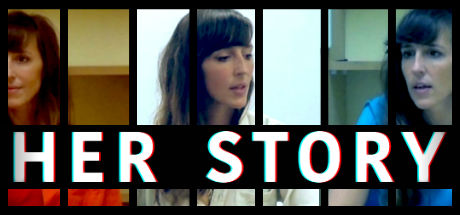
I am probably one of those few people who simply couldn’t bring herself to unravel the ultimate mystery of ‘Her Story’. The full motion video (FMV) game, with a disarmingly simple interface, follows a woman who gives a series of interviews at a police station following the death of her husband.
Created by Sam Barlow, ‘Her Story’ is a unique experience for anyone who loves crime thrillers. He describes the game mechanic as, “If you can Google, you can play Her Story.”
And it’s actually that simple. You sit in front of a police database and go through the woman’s interviews by searching for keywords…the same way you would search for a topic on Google.
But all the interviews are arranged in a non-linear manner. You have to connect the dots and play detective, until you can find out the truth.
Trust me, it is one of those games that will boggle your mind!
However, for me personally I outgrew that initial enthusiasm of trying to solve a crime. It happens! Perhaps because I am the sort of person who prefers movement in order to stimulate the mind. Sitting down for hours with a story – that wasn’t moving fast enough – was in the end a bit demanding.
When you emotionally saturate
As writers we are familiar with the sensation of pouring too much of ourselves into something. Whether that’s an essay, a blog, a product descriptor, or a story, we feel this particular exhaustion that doesn’t really belong to the story…but to us. We end up taking too long to write a sentence. We might avoid editing. Case studies that we were once excited about feel rather dull.
It isn’t because we have run out of the plot, or the narrative itself is no longer interesting. It’s simply that we have outgrown the version of ourselves who started it.
This might happen because:
- There has been a constant upheaval of labels, explanations, and reasons. You have been told too many times as a storyteller what to feel and you are trying to convey that.
- There isn’t any emotional contrast. You are either constantly feeling excited or bored, and hence, there is no movement which makes the emotion only a background noise.

You might be someone who is a-tuned to your emotions, and you aren’t ashamed of letting it flow into your work. Even when you write a product descriptor, you mean every word you say about the feature. But there comes a point when you, too, begin to feel the weight of that work. There isn’t anything else that is balancing out that constant excitement.
I felt that way about ‘Her Story’. I was constantly questioning, constantly thinking about every word I heard. Too much was already too evident. And in the end, it dried my excitement.
Good stories need motion
I am not talking about a constant sense of adventure, but development. ‘Her Story’ has plenty of development and the slow burn aspect of the revelations makes the experience all the more delicious. But then again, the developments simply don’t seem impactful enough.
When you take too long to provide a new piece of information, you have to either make it earth-shattering or you have to introduce it soon enough so that the audience isn’t on the verge of giving up their hopes.

In content writing, we try to put the necessary information at the beginning. Not only because it is ideal for SEO but also, it’s what will hook the audience. Similarly, as you move forward in the piece, you have to keep introducing meaningful movement. That can be a shift in tone or an unexpected contrast – something that changes how the reader sees the previous paragraph.
Taking a step back
‘Her Story’ taught me that not all narratives are meant to carry you endlessly. Some simply accompany you until you’re ready to move again. And that also applies to content writing. Some pieces aren’t meant to be dragged to the finish line as they are. You have to outgrow them so that you can renew what you’re writing. And when that happens, the work feels alive again. Not because it changed, but because you did.